
Jerry Pinkney, Adopted & Illustrated
- BIBLIOGRAPHY
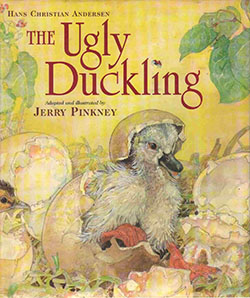
Andersen, Hans Christian. 1999. THE UGLY DUCKLING. Adapted and illustrated by Jerry Pinkney. New York: Morrow Junior Books. ISBN 068815932X.
2. PLOT SUMMARY
The Ugly Duckling is an adaptation of Hans Christian Andersen’s classic by Jerry Pinkney. It is the story of a young bird who is rejected by all but his mother for looking different than the other ducklings. After being mistreated and mocked by those around him, the “ugly duckling” endures through sadness, loneliness, and hardships. However, at the end of his story, he discovers that he was never truly a duck but rather a swan who grew to be beautiful in his own identity.
3. CRITICAL ANALYSIS
The story is a traditional tale that touches on rejection, identity, and a sense of belonging. Pinkney’s adaptation keeps the simplicity and heartfelt emotion of the original tale while making it accessible and understandable for young readers. It takes the reader through an emotional recount of a sense of being lost, but at the end, embracing the true identity of oneself and understanding who they were all along. Although the story embraces the sadness the duckling feels, it is not overwhelmingly painful but rather gives the emotional weight that will offer reassurance to those who may feel different compared to others.
The illustrations of this book are created through watercolors that give in to the natural warmth of the world. The animals are realistic and expressive, and the shift of seasons is evident throughout the book. The change of landscape allows the reader to understand the passing of time during the ducklings’ journey. It brings a sense of sympathy and vulnerability due to the ducklings’ size and differences. For the final pages of the book, the swan itself is a beautiful visual of the duckling’s transformation and journey. Its storytelling and visuals complement each other to ensure the reader gains a complete immersive experience.
4. REVIEW EXCERPT(S)
The American Library Association shares The Ugly Duckling as a Caldecott Honor Book and notes that Pinkney’s illustrations make the animals “come alive.”
School Library Journal calls it “an artistic tour de force that is worthy of its graceful, fine-feathered subject.”
5. CONNECTIONS
- Students can compare this version of THE UGLY DUCKLING with other illustrated versions of the tale. They can draw conclusions as to the differences between the other animal and the final transformation.
- This book can also be used to discuss the present themes, such as belonging, kindness, and personal growth, during counselor-themed weeks. They can share about what it feels like to be left out and the importance of empathy.
- Other Books:
- Andersen, Hans Christian. THE LITTLE MATCH GIRL. Ill. by Jerry Pinkney. ISBN 9780803724648.
Pinkney, Jerry. THE LION AND THE MOUSE. ISBN 9780316013567.
Stead, Philip C. A SICK DAY FOR AMOS MCGEE. Ill. by Erin E. Stead. ISBN 9781596434028.
- Andersen, Hans Christian. THE LITTLE MATCH GIRL. Ill. by Jerry Pinkney. ISBN 9780803724648.
 The Literary Compass