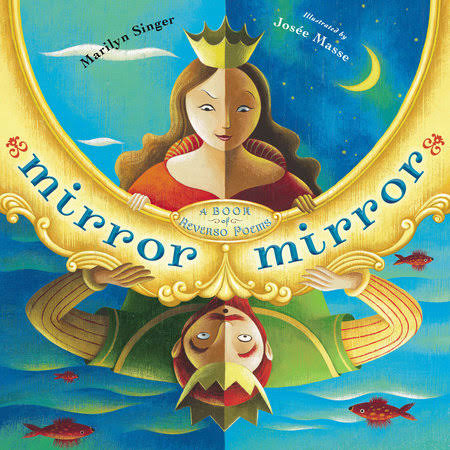
Mirror Mirror

Marilyn Singer, Author

Josee Masse, Illustrator

  1. BIBLIOGRAPHY

Singer, Marilyn. 2010. MIRROR MIRROR: A BOOK OF REVERSO POEMS. Ill. by Josee Masse. New York: Dutton Children’s Books. ISBN 9780525479017.

2.  PLOT SUMMARY

Mirror Mirror is a collection of well-known fairy tale poems that are written in “reverso” form. Each poem begins in its traditional format and then reverses the lines to tell the story from a different perspective. In the alternative version of the poem there is a reversing order of the line and adjusting the punctuation and capitalization to created an mirrored effect of version of the original narrative. 

3. CRITICAL ANALYSIS

This collection of poetry is unique for its structured poetic form. The reverso technique forces the reader to see how meanings can change depending on the word order and perspective. The author uses fairy tales that are well known by the reader, which allows them to highlight how perspective changes interpretation. An example is characters that are calm and passive in one version may have a different stance in power or a misunderstanding in the mirror version. 

The illustrations by Josee Masse complement the mirrored structure as their illustrations themselves are mirrored in color. The artwork visually reflects the duality of the text and allows for contrasting moods to be shown. The colors show the symmetry and opposition, which reflects the reverso concept. 

4. REVIEW EXCERPT(S)

Library Media Connection: “Truly a visual, as well as a literary, puzzle and such a treat!”

Publishers Weekly: “Masse’s clever compositions play with symmetry, bringing this smart concept to its fullest effect.”

5. CONNECTIONS

  • Teachers can challenge students to write out their own reverso poems using familiar fairy tales. 
  • There can also be discussion that allows students to engage in how changing word order changes the meaning or context of a story. 
  • Other Books: 

Singer, Marilyn. FOLLOW FOLLOW
Grimes, Nikki. BRONX MASQUERADE
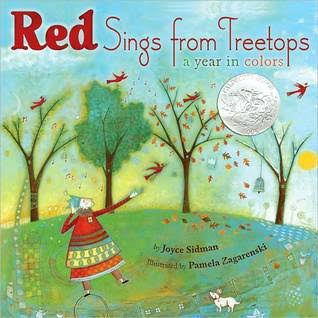
Red Sings from Treetops

Joyce Sidman, Author

Pamela Zagarenski, Illustrator

  1. BIBLIOGRAPHY

Sidman, Joyce. 2009. RED SINGS FROM TREETOPS: A YEAR IN COLORS. Ill. by Pamela Zagarenski. Boston: Houghton Mifflin Books for Children. ISBN 9780547014944.

2.  PLOT SUMMARY

RED SINGS FROM THE TREETOPS: A YEAR IN COLORS is a collection of poems about the changing seasons and their colors. Each poem’s focus is on how colors appear in nature throughout the year. As the poems move through the four seasons, color is shown to shift with the time, weather, and environment. 

3. CRITICAL ANALYSIS

This set of poetry collection uses sensory language to connect the reader to nature in an emotional way. There is personification of color through giving them voices, actions, and personalities throughout the book. It allows for the season and colors to be more engaging and accessible to the reader. The structure allows for each poem to stand alone but also contribute to the larger theme.

The illustrations of this book bring the meaning to what the words are trying to convey. There is a dreamlike imagery with details patterns and symbolic objects that create a whimsical atmosphere. It is an expansion of the author’s intentions. Both the images and poetry work together to create meaning. It does its duty of encouraging the reader to understand through observation and reading. 

4. REVIEW EXCERPT(S)

  • Spirituality and Practice: “Red Sings from Treetops acknowledges the beauty all around us and the beauty within our imaginations. No wonder it is a Caldecott Honor Book Award!”

5. CONNECTIONS

  • This book can be used in the science classroom or art connection lessons about the seasons and colors in nature. Student can be challenged by creating their own poem on a season of their choice. 
  • Related books:

Sidman, Joyce. WINTER BEES
Florian, Douglas. SUMMERSAULTS

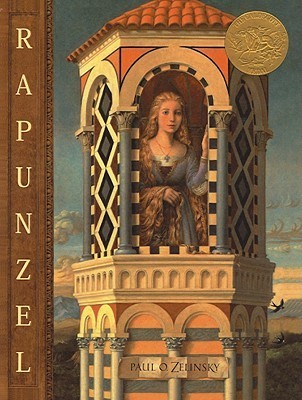
Rapunzel

Paul O. Zelinsky, Author & Illustrator

  1. BIBLIOGRAPHY

Zelinsky, Paul O. 1997. RAPUNZEL. New York: Dutton Children’s Books. ISBN 9780525456070.

2.  PLOT SUMMARY

Paul O. Zelinsky’s retelling of RAPUNZEL follows the traditional fairy tale of a girl who is taken from her parents at birth and raised by a sorceress in a tower. As Rapunzel grows, her hair becomes longer and the only way the sorceress can enter the tower. When a prince passes by and hears her singing, he discovers how to reach her, and they both fall in love. After the sorceress becomes aware of their meeting, they are separated, and both suffer before they are reunited and build their future. 

3. CRITICAL ANALYSIS

The retelling of the story keeps the structure and tone of the traditional tale that includes longing, danger, and separation. The isolation of Rupenzel is the center of the story, while the tower becomes the place of protection and imprisonment. When she finally meets her prince, she has a connection to the outside world, but also the start of her conflict and punishment for having that connection.

The illustrations themselves are a set of oil paintings that give the book a sense of Renaissance-inspired visual style. The artwork gives almost a grand and sacred feel. It is different from the normal cartoon-like images that picture books. They do a good job of communicating emotions such as Rapunzel’s loneliness, the sorceress’s power, and the prince’s longing. The text and illustrations work well together in retelling the traditional tale.

4. REVIEW EXCERPT(S)

Penguin Random House – “As ever, and yet always somehow in newly arresting fashion, Paul O. Zelinsky’s work thrillingly shows us the events of the story while guiding us beyond them to the truths that have made it endure.”

5. CONNECTIONS

  • A good book to introduce students to traditional fairy tales and how stories change over time through cultures and authors. It can be used in a compare and contrast with other retellings of this story.
  • Students can examine the illustrations before reading the text. 
  • Related Books:

Zelinsky, Paul O. RUMPELSTILTSKIN. ISBN 9780525442653.
Zelinsky, Paul O. HANSEL AND GRETEL. Retold by Rika Lesser. ISBN 9780525461524.
Pinkney, Jerry. THE UGLY DUCKLING. ISBN 9780688159320.

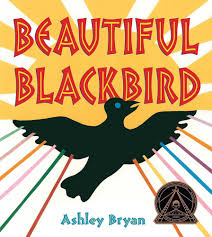
Beautiful Blackbird

Ashley Bryan, Author & Illustrator

  1. BIBLIOGRAPHY

Bryan, Ashley. 2003. BEAUTIFUL BLACKBIRD. New York: Atheneum Books for Young Readers. ISBN 9780689847318.

2.  PLOT SUMMARY

BEAUTIFUL BLACKBOARD is the beautiful retelling of a Zambian folktale about a group of colorful birds who admire the beauty of Blackbird. The other birds are a bright shade of reds, yellows, greens, blues, and purples, and they believe that Blackbird is the most beautiful because of his beautiful, deep black color. In their awe, they ask Blackbird to share some of his black coloring with them, and he then paints markings on their feathers. As he does so, he reminds them that their true beauty comes from within, not from the outside. They celebrate the beauty that black adds to their outward appearance. 

3. CRITICAL ANALYSIS

This tale works well as a folktale because of its use of repetition, rhythm, animal character, and direct lesson. It is the tale of why birds may have many black markings, but it also carries the significance of beauty, identity, and self-worth. It creates a celebration of the Blackbird and its black color as something beautiful, valuable, and desirable. The book draws a powerful conversation on the importance of embracing one’s identity, culture, and values, and recognizing the many forms of beauty. 

The illustrations of the book play a significant role as the bright colors and dark black are essential to the storyline. Throughout the book, the birds look lively and joyful, and the transition of when they gain their black color is evident. It is a deep contrast that adds pattern and beauty to the other birds. 

4. REVIEW EXCERPT(S)

School Library Journal – “This unusual and little-known pourquoi tale may supplement larger collections and serves as a thoughtful and entertaining addition to units on self-esteem.”

Publishers Weekly – “Bryan’s lilting and magical language is infectious.”

5. CONNECTIONS

  • Students can read this book in a classroom setting and then participate in a collage bird-making art world in which they can then add their own black markings. They can then share and tell what makes their bird unique. 
  • Related Books:

Bryan, Ashley. LET IT SHINE: THREE FAVORITE SPIRITUALS. ISBN 9780689847325.
Bryan, Ashley. THE DANCING GRANNY. ISBN 9780689711589.
Morales, Yuyi. JUST A MINUTE: A TRICKSTER TALE AND COUNTING BOOK. ISBN 9780811837583.

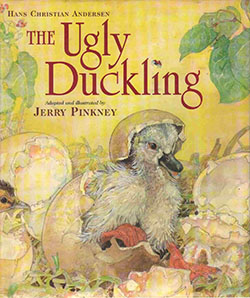
The Ugly Duckling

Jerry Pinkney, Adopted & Illustrated

  1. BIBLIOGRAPHY

Andersen, Hans Christian. 1999. THE UGLY DUCKLING. Adapted and illustrated by Jerry Pinkney. New York: Morrow Junior Books. ISBN 068815932X.

2.  PLOT SUMMARY

The Ugly Duckling is an adaptation of Hans Christian Andersen’s classic by Jerry Pinkney. It is the story of a young bird who is rejected by all but his mother for looking different than the other ducklings. After being mistreated and mocked by those around him, the “ugly duckling” endures through sadness, loneliness, and hardships. However, at the end of his story, he discovers that he was never truly a duck but rather a swan who grew to be beautiful in his own identity. 

3. CRITICAL ANALYSIS

The story is a traditional tale that touches on rejection, identity, and a sense of belonging. Pinkney’s adaptation keeps the simplicity and heartfelt emotion of the original tale while making it accessible and understandable for young readers. It takes the reader through an emotional recount of a sense of being lost, but at the end, embracing the true identity of oneself and understanding who they were all along. Although the story embraces the sadness the duckling feels, it is not overwhelmingly painful but rather gives the emotional weight that will offer reassurance to those who may feel different compared to others. 

The illustrations of this book are created through watercolors that give in to the natural warmth of the world. The animals are realistic and expressive, and the shift of seasons is evident throughout the book. The change of landscape allows the reader to understand the passing of time during the ducklings’ journey. It brings a sense of sympathy and vulnerability due to the ducklings’ size and differences. For the final pages of the book, the swan itself is a beautiful visual of the duckling’s transformation and journey. Its storytelling and visuals complement each other to ensure the reader gains a complete immersive experience. 

4. REVIEW EXCERPT(S)

The American Library Association shares The Ugly Duckling as a Caldecott Honor Book and notes that Pinkney’s illustrations make the animals “come alive.”

School Library Journal calls it “an artistic tour de force that is worthy of its graceful, fine-feathered subject.”

5. CONNECTIONS

  • Students can compare this version of THE UGLY DUCKLING with other illustrated versions of the tale. They can draw conclusions as to the differences between the other animal and the final transformation.
  • This book can also be used to discuss the present themes, such as belonging, kindness, and personal growth, during counselor-themed weeks. They can share about what it feels like to be left out and the importance of empathy. 
  • Other Books:
    • Andersen, Hans Christian. THE LITTLE MATCH GIRL. Ill. by Jerry Pinkney. ISBN 9780803724648.
      Pinkney, Jerry. THE LION AND THE MOUSE. ISBN 9780316013567.
      Stead, Philip C. A SICK DAY FOR AMOS MCGEE. Ill. by Erin E. Stead. ISBN 9781596434028.

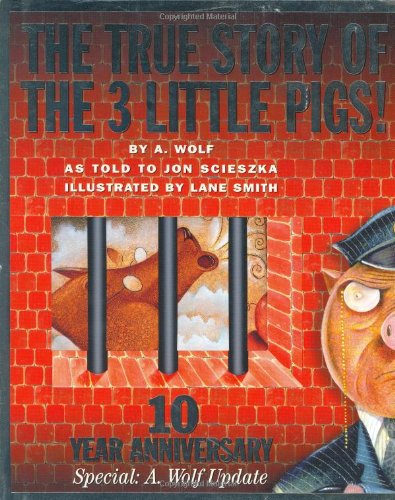
The True Story of the 3 Little Pigs!

Jon Scieszka, Author

Lane Smith, Illustrated

  1. BIBLIOGRAPHY

Scieszka, Jon. 1989. THE TRUE STORY OF THE 3 LITTLE PIGS! Ill. by Lane Smith. New York: Viking Books for Young Readers. ISBN 9780670827596.

2.  PLOT SUMMARY

THE TRUE STORY OF THE 3 LITTLE PIGS!, is a retelling of the familiar story of “The Three Little Pigs”, from the wolf’s point of view. Alexander T. Wolf retells his story as a claim of innocence, stating that he was not “big and bad” but simply misunderstood. His demise came from the simple need for a cup of sugar to bake a cake for his grandmother and his cold that caused him to sneeze away his neighbors’ homes. He becomes the unmistakable villain in this story and simply tries to prove his innocence to the reader and the author. 

3. CRITICAL ANALYSIS

This picture book takes the story of a well-known fairytale and turns it upside down in a clever and humorous way. The narration is taken over by the wolf himself in order to clear his name once and for all. By setting his personality as being someone who is polite, reasonable, and innocent, the writing of this book almost lets you believe the world itself is innocent. 

The illustration in this book is essential to the humor Scieszka conveys. It is relative to a dark and gothic newspaper-like illustration that feeds into the tabloid or crime investigation aesthetic. Smith gives the wolf a look of innocence through his charming and put-together wardrobe and accessories. 

This book allows the reader to immerse themselves as someone on the jury and hear the other side of the story. Will they side with the wolf? Or will the stay true to the original story of “The Three Little Pigs”?

4. REVIEW EXCERPT(S)

  • The True Story of the 3 Little Pigs is #35 on School Library Journal’s list “Top 100 Picture Books” of all time. 
  • The Big Bad Wolf tells his side in this fractured fairy tale, brought to life with irreverent storytelling and artwork that “older kids (and adults) will find very funny” (School Library Journal).

5. CONNECTIONS

  • This story would pair well with the traditional version of “The Three Little Pigs”. When both books are read, you can draw a comparison between the two stories and have a discussion on which one seems more probable. 
  • Related books:

Wiesner, David. THE THREE PIGS. ISBN 9780618007011.

Scieszka, Jon. THE STINKY CHEESE MAN AND OTHER FAIRLY STUPID TALES. Ill. by Lane Smith. ISBN 9780670844876.

Finding Winnie

Lindsay Mattick, Author

Sophie Blackall, Illustrator

  1. BIBLIOGRAPHY

Mattick, Lindsay. 2015. FINDING WINNIE: THE TRUE STORY OF THE WORLD’S MOST FAMOUS BEAR. Ill. by Sophie Blackall. New York: Little, Brown Books for Young Readers. ISBN 9780316324908. 

2.  PLOT SUMMARY

Finding Winnie is the true story behind the bear that inspired the Winnie-the-Pooh adventures. The book begins as a story told by Lindsey to her son, Cole. She introduces Harry, a veterinarian and soldier who purchased a cub from a train station on his way to his post. He named the bear Winnipeg, Winnie for short, after the town he was from. The cub traveled with him and his unit but eventually ended up in the London Zoo. This is where Winnie would meet Christopher Robin, which would draw the inspiration for the Winnie-the-Pooh stories.

3. CRITICAL ANALYSIS

Finding Winnie is a blend of history, biography and storytelling through the intimate retell of the life of Winnie-the-Pooh. Lindsay Mattick, paves a intimate narrative between a mother and her son which seem like just the telling of a random bed time story. However, as the story progresses, the family tree is shared and the connections of the story are drawn to emphasis the importance of this story. 

The illustrations of this book support the emotional and historical layers of the story line. It is detailed, intimate, and nostalgic to draw readers to move through the various timelines of the story. The illustration of the cub is done wit the intention of keeping a nonfiction perspective but also blending in with the cartoonish personality. 

4. REVIEW EXCERPT(S)

School Library Journal – “A perfect melding of beautiful art with soulful, imaginative writing, this lovely story, penned by Colebourn’s great-great granddaughter, is ideal for sharing aloud or poring over individually. VERDICT Children everywhere will enjoy this tale for years. A must-have.”

5. CONNECTIONS

  • A book that can be used for narrating nonfiction, history, and the real stories behind fictional characters.
  • Other Winnie-the-Pooh books:

Milne, A. A. WINNIE-THE-POOH. ISBN 9780525444435

Walker, Sally M. WINNIE: THE TRUE STORY OF THE BEAR WHO INSPIRED WINNIE-THE-POOH. ISBN 9780805097153Appelt, Kathi. MISS LADY BIRD’S WILDFLOWERS. ISBN 9780060011071

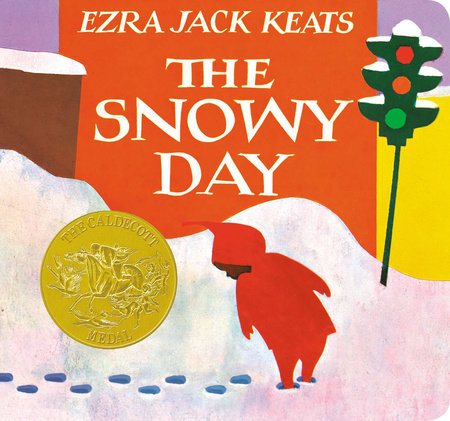
The Snowy Day

Ezra Jack Keats, Author

  1. BIBLIOGRAPHY

Keats, Ezra Jack. 1962. THE SNOWY DAY. Ill. by Ezra Jack Keats. New York: Viking Press. ISBN 9780670654000. 

2.  PLOT SUMMARY

Peter wakes up to find that snow has fallen overnight in his neighborhood. In excitement, he puts on his red snowsuit and ventures outside to explore the fallen snow. He makes tracks in different directions and finds a stick that helps him knock snow off the tree. As he continues on his journey, he watches the older children have a snowball fight and decides to build a snowman, make snow angels, and save some snow for the next day in his pocket. When he returns home, he tells his mom about his adventure, ponders, and checks his pocket for the snow. To his sad surprise, the snow has melted, and he dreams that the sun has melted all the snow outside. However, when morning breaks, he finds that more snow has fallen and enjoys a new day of adventures with a friend.

3. CRITICAL ANALYSIS

The Snowy Day is a gentle recount of a child’s experience with a snow day. Peter goes about his day enjoying the small discoveries such as footprints, snow angels, the disappointment of melting snow, and the excitement of waking up to a world of white and cold. It is a quiet book that does not overwhelm the reader, but rather allows them to enjoy the simplicity of seeing life through a child’s eyes. 

The illustrators are the main characters as they communicate the beauty and coldness of snow, but also the warmth of the sun as it melts the ice. Peter stands out in his beautiful red snow suit amongst the white blankets of snow. The author also uses words to imitate the crunch of snow or the plopping of the snow that fell on Peter. 

4. REVIEW EXCERPT(S)

Winner of the 1963 Caldecott Medal

The Horn Book: “In this book sparkling with atmosphere, a small boy experiences the joys of a snowy day. The brief, vividly expressed text points out his new awareness”

Publisher’s Weekly: “pays homage to the wonder and pure pleasure a child experiences when the world is blanketed in snow.”

5. CONNECTIONS

Books on Snow:

Glaser, Linda & Swan, Susan. It’s Winter! ISBN 0761316809

Fleming, Denise. The First Day of Winter. ISBN 0312371388

Branley, Franklyn M. & Keller, Holly. Snow is Falling. ISBN 0064451864

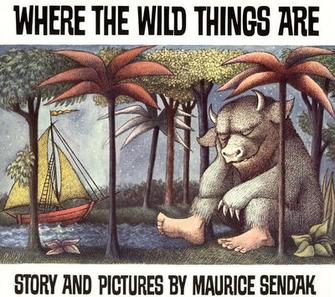
Where the Wild Things Are

Maurice Sendak, Author & Illustrator

  1. BIBLIOGRAPHY

Sendak, Maurice. 1963. WHERE THE WILD THINGS ARE. Ill. by Maurice Sendak. New York: Harper & Row. ISBN 9780060254926. 

2.  PLOT SUMMARY

Max, a boy who loves his wolf suit and loves to cause mischief in the comfort of his home. The mischief led to no supper and was sent straight to his room as a consequence. In his room, a forest begins to grow, and Max sails away to the land of Wild Things. He becomes king of the Wild Things and tames them as a king would, in confidence and heavy imagination. In due time, Max grew tired of his duties and longed to be home where he wouldn’t be lonely. He sails back to the reality of his room, where he finds supper waiting for him, still hot.

3. CRITICAL ANALYSIS

Sendak’s story is one of mischief, imagination, and returning to the things that matter. It touches on the emotional capacities of a childhood, in which the character experiences anger, adventure, power, imagination, loneliness, and a need to return home. 

The text is straight to the point, but the illustrations allow for the imagination of the land of the Wild Things to come alive. The transition between the reality of his room and the imagination of a forest where monsters live is smoothly handled to show the emotional journey Max undergoes. 

4. REVIEW EXCERPT(S)

“Each word has been carefully chosen, and the simplicity of the language is quite deceptive.” ―School Library Journal

Library Journal voted Where the Wild Things Are as the number one picture book in 2012.

5. CONNECTIONS

  • A perfect book to discuss emotions that children might feel when encountering anger, imagination, and loneliness. 
  • Children can draw their own “wild thing” to engage in their imagination.
  • Other Books: 

Viorst, Judith. ALEXANDER AND THE TERRIBLE, HORRIBLE, NO GOOD, VERY BAD DAY. ISBN 9780689711732

Sendak, Maurice. IN THE NIGHT KITCHEN. ISBN 978006026668

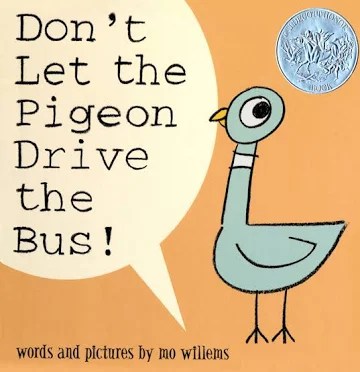
Don’t Let the Pigeon Drive the Bus! 

Mo Williams, Author & Illustrator

  1. BIBLIOGRAPHY

Willems, Mo. 2003. DON’T LET THE PIGEON DRIVE THE BUS! Ill. by Mo Willems. New York: Hyperion Books for Children. ISBN 9780786819881. 

2.  PLOT SUMMARY

A bus driver steps away from his bus with one simple instruction left for the reader, don’t let the pigeon drive the bus! The pigeon makes his debut and immediately starts to beg the reader to allow them to drive the bus. It goes from begging to whining, to bargaining, to throwing a full tantrum when they are not allowed to drive the bus. The reader becomes a part of the story through page interaction and essentially is called to deny the request of a very dramatic pigeon. When the bus driver finally returns, the pigeon is defeated in their request to drive the bus. However, a truck comes around, and the pigeon has now found a new desire.

3. CRITICAL ANALYSIS

DON’T LET THE PIGEON DRIVE THE BUS! Is a engaging book that introduces humor, real world scenarios and active audience participation. The reader was given an instruction and engages with the pigeon throughout the book to ensure that he does not infact drive the bus. This book is effective for younger readers because it allows them to be respond to the narrative, laugh and have some decision making input throughout the story. The dialogue is composed of short responses such as you would have in conversation with a child. There is a range of exaggeration on how the pigeon responds to not being allow to do what their hearts biggest desire is, to drive the bus. 

The illustrations to the book are simple, however, the pigeon wears some very expressive emotions throughout the story. You are able to see the his desire to drive the bus and the sneakiness of trying to convince the reader to allow them to take the wheel. His attitude shifts to direct rage and defeat when the bus driver finally returns and he was in fact not allowed to drive the bus. 

4. REVIEW EXCERPT(S)

Publishers Weekly: “The premise of this cheeky debut is charmingly absurd. Willems hooks his audience quickly with the pigeon-to-reader approach and minimalist cartoons. The bluish-gray bird expresses countless, amusing emotions through tiny shifts in eye movement or wing position.”

Reformed Perspective: “The Pigeon uses every excuse you’ve ever heard a child use: ‘I never get to do anything!’…”

5. CONNECTIONS

  • This book can be used with children during storytime to discuss the importance of making wise choices, following instructions, and “no means no”. 
  • Related Mo Williams books:

Willems, Mo. THE PIGEON FINDS A HOT DOG! ISBN 9780786818693

Willems, Mo. KNUFFLE BUNNY: A CAUTIONARY TALE. ISBN 9780786818709

Willems, Mo. EDWINA, THE DINOSAUR WHO DIDN’T KNOW SHE WAS EXTINCT. ISBN 9780786837489